 chuck
Educational guide based on our supplied DIY glossary. No hands-on testing or external source verification. Check current instructions for your exact tools and materials.
Describe the cut before choosing the tool
“I need a saw” is a starting point, but “I need to trim a few lengths of timber square” is a much better buying brief. Think about the material, its thickness, whether the cut is straight or curved, and how tidy the finished edge needs to be.
Also consider how often you will repeat the task. An occasional small repair and a room full of repeated cuts can justify very different equipment. The cheapest purchase is not always the most economical, but buying a larger machine than you can store or support properly creates its own problems.
A hand saw may be enough
For a small number of suitable timber cuts, a hand saw can be a sensible first option. It needs no battery system and takes relatively little storage space. Look for a saw intended for the material and finish you need, rather than assuming every hand saw is interchangeable.
A hacksaw serves a different purpose. Its fine-toothed blade is commonly used for metal, plastic and small pipes. Material suitability still depends on the blade, and cutting an installed pipe requires more investigation than cutting a loose piece of stock.
Straight cuts, curves and repeated angles
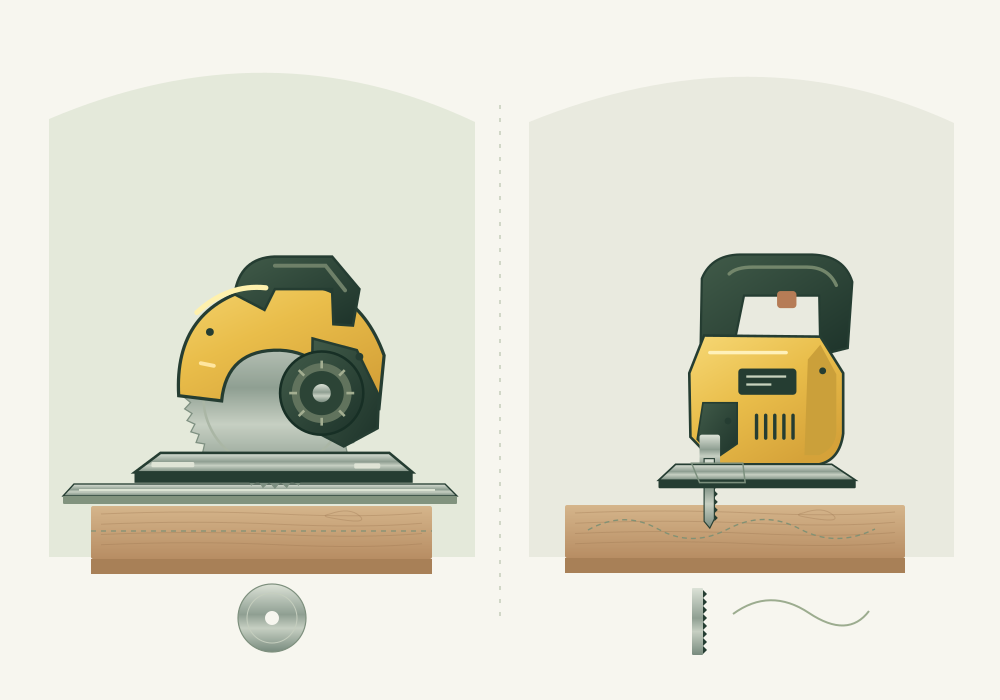
A circular saw is commonly used for straight cuts in timber and sheet material. It belongs in a setup where the workpiece can be supported securely and the tool can be used as its manufacturer intends. The support and space required are part of the purchase decision.
A jigsaw uses a narrow blade that moves backwards and forwards. It can suit curves and shaped cut-outs as well as straight cuts, with the right blade and setup. A mitre saw is designed around crosscuts and angled cuts, making it worth considering when repeated cuts across suitable lengths are the main job.
- Straight sheet cuts: investigate circular-saw systems and suitable work support.
- Curves and shapes: investigate jigsaws and material-specific blades.
- Repeated crosscuts and angles: investigate mitre saws and the space around them.
Do not confuse access with suitability
A reciprocating saw can be useful for certain demolition and access work, but that does not make it a substitute for every other saw. A rough removal task and a visible joinery edge have different priorities.
Before choosing a tool for anything already installed, establish what is behind or within the material. Hidden services, unknown fixings and hazardous building materials can change whether the work is suitable to tackle at all. A glossary definition cannot settle that question.
Budget for the whole setup
Compare the tool together with its correct blade, compatible batteries and charger where needed, work support and any manufacturer-specified dust-control arrangements. A bare tool price does not describe the cost of a usable setup.
Check the manual for allowed materials, accessories and operating limits. Think about storage, noise, dust and the space needed around the workpiece. Blade binding can cause kickback: follow the tool instructions and get practical guidance if you have not used that type of saw before.
This is a tool-selection explainer drawn from our glossary, not a cutting lesson or a tested product ranking. Once you know the type of saw you need, compare exact models against your actual jobs.
The takeaway
- Choose for the material, cut shape and finish first.
- Include support, blades and accessories in the buying decision.
- A powered saw is not automatically the best answer to a small job.