Planning a small workshop that works for you
Make room for the work, storage and everyday habits that matter before filling a small workshop with equipment.
Read the guide → chuck & bit.Our approach
Plan a small DIY workspace around the material, support, storage and access your projects actually need.
Open the planning checklist ↓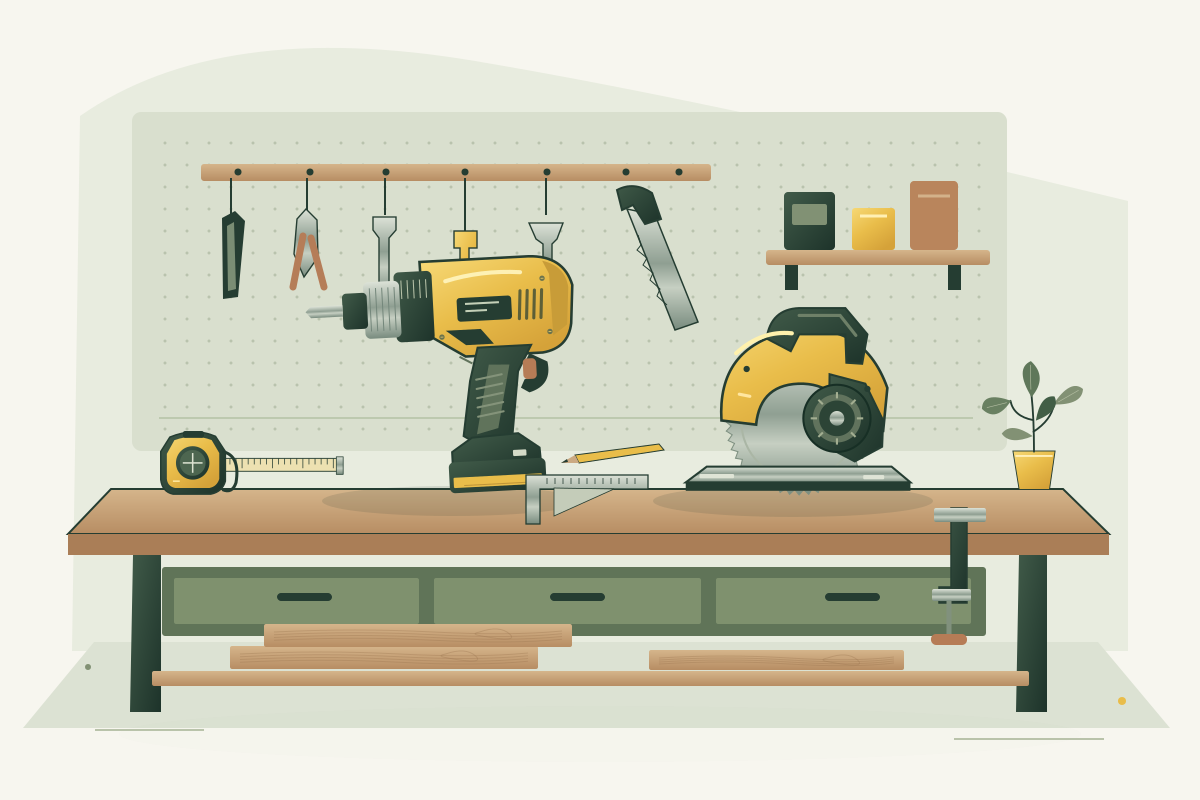
A useful workspace does not begin with filling every wall or buying the largest bench that fits. Start with the work you want to do, the material you need to handle and how the space has to function at other times. A corner of a shared garage has different needs from a dedicated room. This guide helps build a brief before choosing furniture or machines.
List the activities: measuring, assembly, light repairs, preparation or suitable cutting work. Think about the size of the material at the beginning and end of a task. The machine footprint alone does not describe the working area or the clearance needed around it.
Consider doors, walkways, household storage, parked vehicles and other people. Plan how equipment is secured and how access stays clear. If the space changes use, a simple arrangement that can be put away may be more useful than a permanently crowded setup.
Look at lighting, ventilation, noise, dust and the building’s suitability for the proposed work. New electrical arrangements and structural changes need the appropriate assessment. A workspace plan should identify those requirements rather than assume a collection of extension leads or open doors solves them.
Choose exact equipment only when the task and its requirements are clear.
Choose for the tasks, material and supported loads described by the product or design. Stability, height and clamping access matter. A large tabletop is not automatically a safe substitute for a suitable workbench.
Clamps, vices and supports need to fit the work and the available mounting points. Plan where the workpiece is supported throughout a task, rather than expecting your free hand to hold everything in position.
Keep frequently used tools accessible while protecting sharp accessories and batteries as their instructions require. Leave space for materials and partly completed projects. Storage is useful when it makes the next setup clearer, not simply denser.
The material and process determine the controls needed. A tidy floor and a basic household vacuum are not proof that fine dust is controlled. Identify the exact equipment and precautions required before choosing a dusty activity for the space.
Use these checks to identify the information you still need. Ticking a box records your own planning; it does not certify the installation or the work.
The checklist is temporary and stays in this page. Nothing is submitted or saved.
A neatly arranged workshop image cannot show whether a long board can be handled or whether the door opens fully. Test the proposed layout against your real materials and access routes.
A new tool can bring support, extraction, storage and maintenance needs. Make room for the complete working setup before deciding that the machine itself fits.
Shelves and cabinets can consume the same space needed for assembly or an unfinished project. Keep a deliberate working area rather than filling the room to its storage limit.
The aim is a workspace you can use comfortably and put back into a clear state. Start with a workable layout and a small set of suitable equipment. Let repeated jobs show you what is missing before adding storage or machines that make the space harder to use.
Make room for the work, storage and everyday habits that matter before filling a small workshop with equipment.
Read the guide →A practical introduction to clamp types, contact points and the buying decisions that make workholding easier to plan.
Read the guide →Choose a useful reference edge, understand what your measuring tools tell you and mark a job clearly before cutting or fixing.
Read the guide →Choose a small, useful collection around the jobs you expect to do, with room to grow as you learn.
Read the guide →